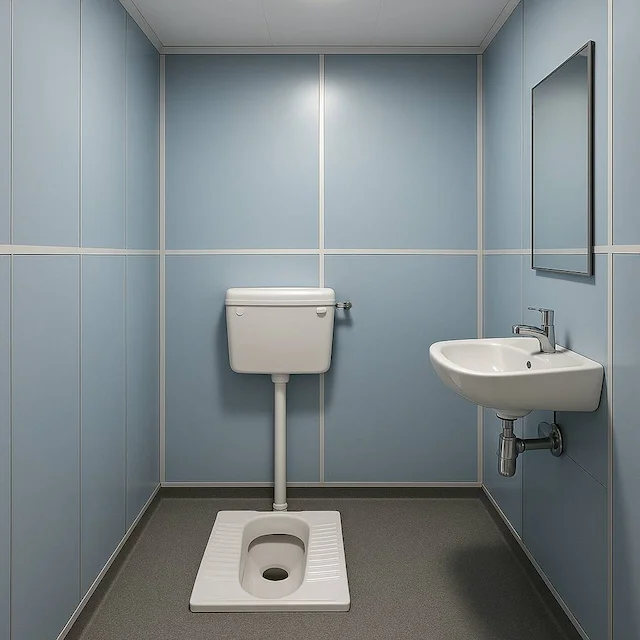
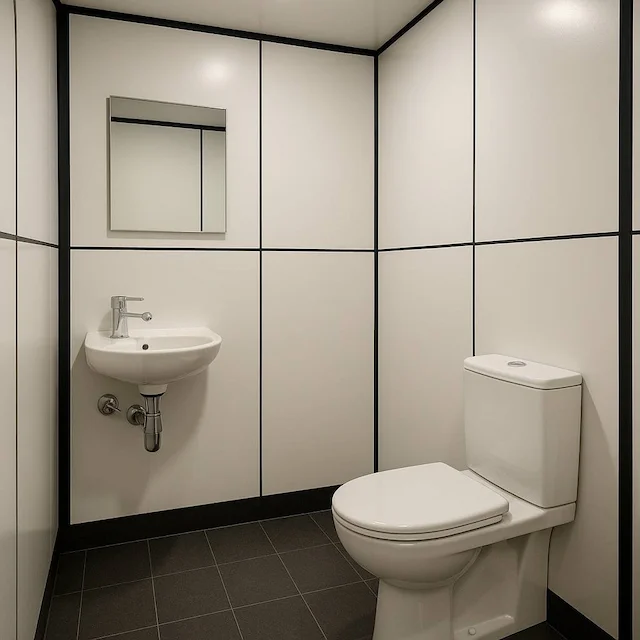
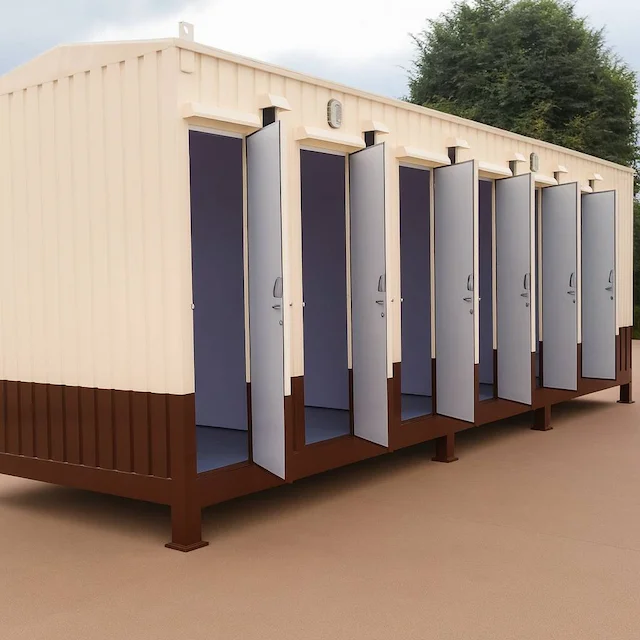
Product Overview
Detailed information about
Cabin with Toilet
Introduction: Why Portable Cabins with Toilets Are the Smartest Worksite Upgrade
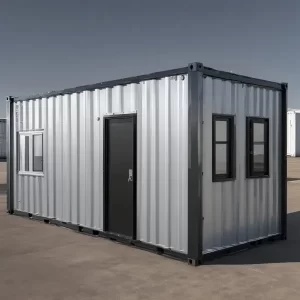
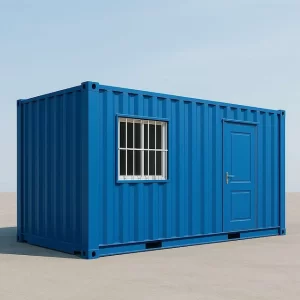
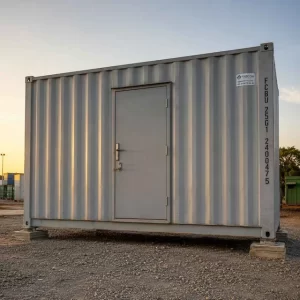
A portable cabin with toilet combines workspace convenience and sanitation in a single prefabricated unit. Designed for project offices, industrial zones, and remote locations, these cabins eliminate the need for separate restrooms—saving both space and setup time.
Modern units arrive fully equipped with plumbing, ventilation, and electrical systems. Unlike traditional sheds, they are factory-built under controlled quality checks, ensuring long life, hygienic interiors, and fast deployment.
According to market data, demand for portable toilet cabins in India grew nearly 30 % in 2024 as developers, government agencies, and construction firms sought integrated workspace solutions that comply with sanitation norms.
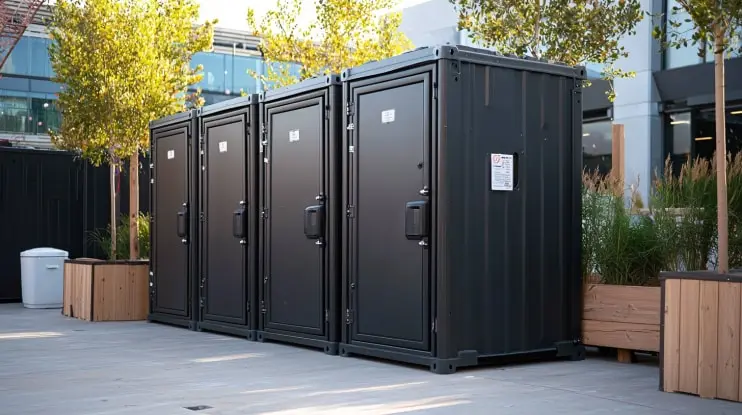
1.1 Evolution of Integrated Portable Cabins
Early site offices relied on two separate cabins—one for staff and another for restrooms. Integration changed that.
Now, a single cabin can include:
- One to two executive work zones
- Partitioned washroom or toilet area
- Sink + handwash + fresh-water storage
- Exhaust fan and proper drainage outlet
This design ensures privacy, hygiene, and cost-effectiveness—vital for fast-moving projects and temporary facilities.
1.2 Benefits Over Separate Toilet Cabins
| Aspect | Separate Toilet Unit | Portable Cabin with Toilet | Practical Outcome |
| Space Required | Two structures | One compact unit | Saves up to 30 % area |
| Installation Time | 3–4 days | 1–2 days | 50 % faster setup |
| Maintenance Cost | Dual service | Shared plumbing | Lower recurring cost |
| Comfort & Privacy | Basic utility | Office-grade finishes | Better user experience |
| Mobility | Two transport loads | Single load | Half the logistics cost |
These metrics prove that combining workspace and sanitation inside one prefab structure improves efficiency without compromising hygiene.
1.3 Connection to Broader Prefab Solutions
A portable cabin with a toilet is part of the growing family of Portable Cabins—versatile steel or PUF structures used across India for offices, canteens, classrooms, and worker facilities.
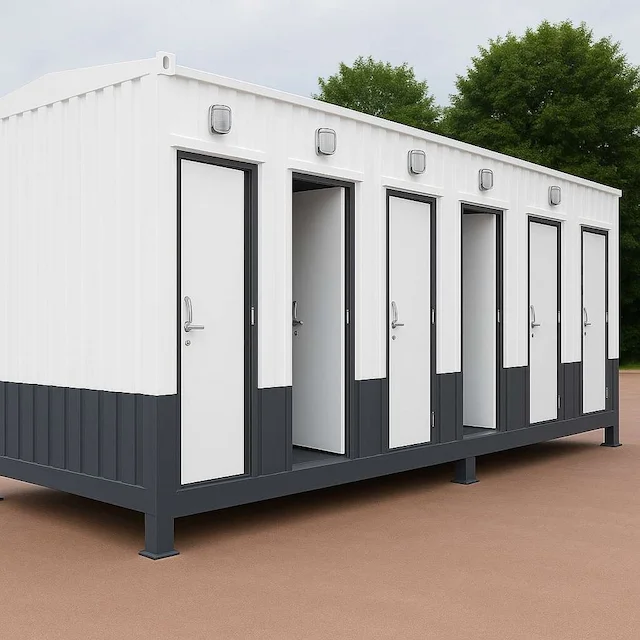
For buyers seeking dedicated sanitation units, our Toilet Portable Cabins page explains options ranging from single-seater FRP cabins to multi-user luxury restrooms.
Those looking for managerial setups with conference areas can also explore the Portable Cabin Office with Toilet guide—an advanced variant with full workspace ergonomics
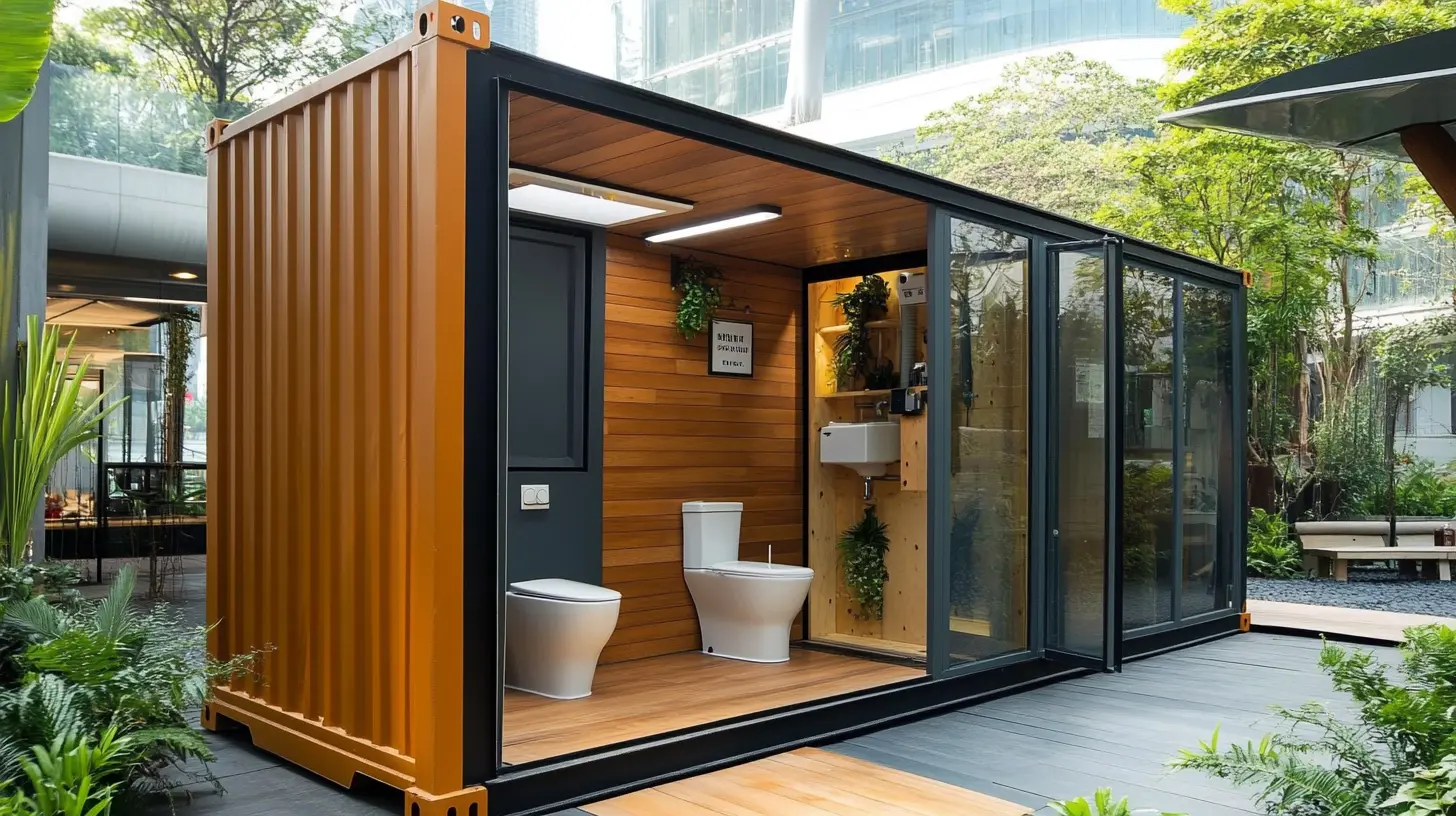
1.4 A Global Perspective
Globally, portable sanitation remains a crucial part of health compliance.
The Wikipedia entry on Portable Toilets traces its evolution from fiberglass booths to modular, eco-friendly cabins, proving how innovation now blends hygiene with architecture.
By adapting these global best practices, Indian manufacturers like JBM Containers deliver high-quality cabins that meet both aesthetic and functional expectations for 2025 and beyond.
Design & Technical Specifications of Portable Cabin with Toilet
The success of any portable cabin with toilet lies in how smartly the layout uses limited space. Each inch is engineered for comfort, ventilation, and compliance—without sacrificing mobility or strength.
Modern cabins follow ergonomic principles found in premium prefab offices while integrating concealed plumbing and waterproofing systems designed for long-term use.
2.1 Standard Layouts and Sizes
Portable cabins come in multiple layouts depending on team strength, purpose, and available land area. A typical layout includes one working zone, a washroom partition, and basic utilities.
| Cabin Type | External Size (ft) | Built-up Area (sq ft) | Toilet Section | Ideal Use |
| Compact | 10×8×8.5 | 80 | 1 Seater | Security / field office |
| Standard | 20×10×9 | 200 | 1–2 Seater | Site offices / consulting rooms |
| Executive | 30×10×9.5 | 300 | 1–2 Seater + sink | Project management |
| Premium | 40×10×9.5 | 400 | Toilet + shower + basin | Corporate field HQ |
Key takeaway: A 20×10×9 ft configuration offers the best balance between mobility and comfort for small to mid-sized teams.
2.2 Structural & Material Composition
| Component | Common Material | Technical Details | Maintenance Frequency |
| Frame | Mild Steel IS-grade | 2 mm thick square hollow sections | Annual paint coat |
| Wall Panels | PUF (40 mm) / ACP | Thermal insulation + weather protection | 3-year lifespan before repaint |
| Roof | PPGI two-way sloped | Leak-proof, thermally coated | Inspect every 12 months |
| Floor | Marine ply + Vinyl | Anti-skid, moisture-proof | Replace vinyl every 3 years |
| Door & Windows | uPVC frame + MS grill | Toughened glass (5 mm) | Clean monthly |
| Toilet Fixtures | Ceramic / FRP | IS 2556 standard | As per use intensity |
This combination ensures all-season comfort, energy efficiency, and long-term savings.
2.3 Smart Plumbing and Electrical Design
- Separate pipelines for clean and waste water.
- Overhead fresh-water tank (200–500 L).
- Concealed electrical wiring in PVC conduits.
- Energy-efficient LED lighting and 15A sockets.
- Exhaust fan and optional mini water heater.
- Power inlet: 32A industrial socket for direct connection to site generator.
These design elements keep cabins self-sufficient even in off-grid or rural areas.
2.4 Key Design Benefits
- Zero Leakage Assurance– Seamless panel joints prevent seepage.
- All-Weather Build– Roof insulation reduces inside heat by up to 8°C.
- Hygienic Interiors– Smooth vinyl flooring resists stains and odor.
- Compact Plumbing Access– Maintenance door for quick inspection.
- Privacy– Full-height partition between toilet and workspace.
- Quick Relocation– Crane hooks and forklift slots pre-integrated.
- Future Upgrade Ready– Provision for adding shower or urinal unit later.
2.5 Technical Insight Table — Power, Water & Drainage
| Parameter | Standard Spec | Upgradable Spec | Notes |
| Power Load | 2 kW | 3.5 kW | AC / Geyser use |
| Tank Capacity | 300 L | 500 L | Non-metallic tanks preferred |
| Drain Type | PVC 110 mm | Bio-treatment outlet | Optional green upgrade |
| Voltage | 230 V / 50 Hz | Solar hybrid system | Optional off-grid setup |
| Floor Load | 250 kg/m² | 350 kg/m² | Suits heavy furniture or file racks |
Cabins sharing these design standards are part of our broader Portable Cabins range, which includes industrial, residential, and sanitation models.
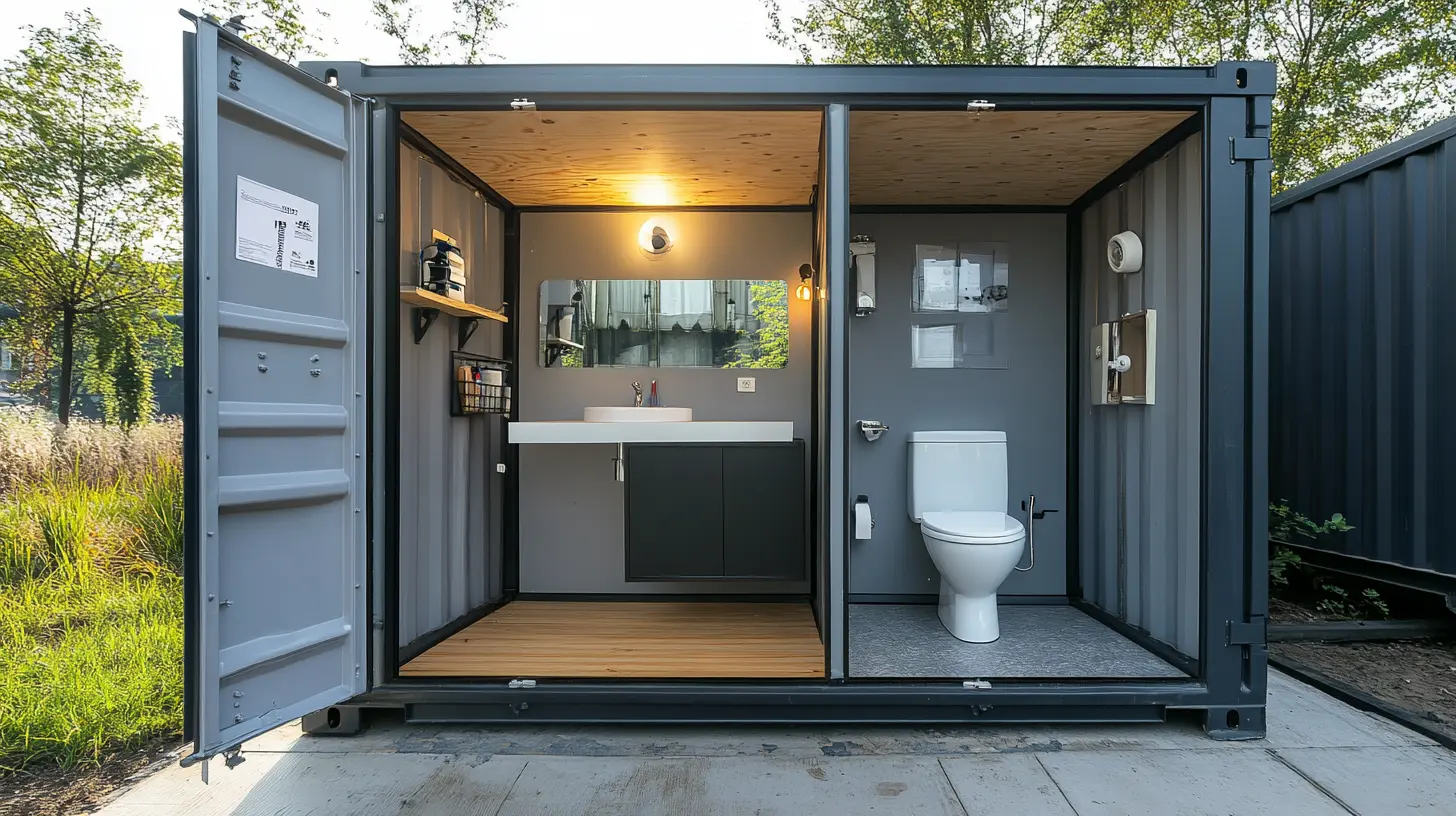
Manufacturing Process & Quality Control
Behind every reliable portable cabin with toilet lies a precise manufacturing cycle.
Each stage — from cutting steel to final inspection — ensures the cabin is watertight, weatherproof, and built to last for years of on-site service.
3.1 Step-by-Step Manufacturing Workflow
| Stage | Process | Tools / Equipment | Quality Checkpoint |
| 1 | Frame Fabrication | MIG welding machine | Dimensional accuracy ±3 mm |
| 2 | Surface Treatment | Anti-rust primer, zinc coating | Salt spray test (72 hrs) |
| 3 | Panel Assembly | PUF / ACP panels bolted & sealed | Joint leakage inspection |
| 4 | Flooring Installation | Marine ply + vinyl mat | Water pond test |
| 5 | Electrical Fittings | Conduits, sockets, lights | Voltage & insulation check |
| 6 | Plumbing Integration | PVC piping, tanks, fixtures | Leak test (2 bar pressure) |
| 7 | Painting & Finishing | PPGI / PU coating | Scratch & adhesion test |
| 8 | Final Inspection | Cross-verification | QC report certification |
Every cabin undergoes a 21-point final inspection before dispatch — including door alignment, tank integrity, and insulation thickness verification.
3.2 Precision Welding and Structural Reinforcement
Each base frame is crafted using 2 mm IS 2062-grade steel sections welded under jigs to ensure geometric uniformity.
Corners are double-welded to handle lifting stress during relocation.
Non-destructive tests (NDT) are performed to detect any surface cracks before priming.
Quick Stats
- Frame lifespan: 15+ years
- Max stacking height (for transport): Two units
- Load-bearing strength: 350 kg/m² (certified)
3.3 Quality Assurance & Testing Protocols
| Inspection Type | Conducted By | Frequency | Criteria |
| Material Verification | Procurement team | Per batch | IS & ASTM compliance |
| Welding Test | Internal QA | Per frame | Visual + ultrasonic |
| Paint Thickness | Coating inspector | Per cabin | ≥ 80 microns |
| Electrical Load | Final QC | Per order | No voltage drop ±5 % |
| Plumbing & Tank Leak | QC engineer | Every cabin | Zero seepage tolerance |
These checks ensure that cabins are ready for field conditions across coastal, dry, and industrial regions.
3.4 Hygiene & Safety Standards
Each toilet cabin is factory-fitted with a sealed septic system or bio-digester, preventing contamination or odor leaks.
All water lines use food-grade PVC, while the interior paint is anti-fungal and non-toxic.
Safety Features
- Fire-retardant insulated panels
- Anti-slip vinyl flooring
- Ventilated skylight for natural airflow
- Earthing and circuit protection system (MCB + ELCB)
3.5 Integration with National Standards
All production follows BIS 875 Part 2 (Structural Loads) and NBC 2016 guidelines for temporary structures.
Environmental compliance aligns with the Swachh Bharat Mission and FSSM framework for waste management.
JBM Containers also references ISO 9001:2015 for its in-house manufacturing process, ensuring every portable cabin with toilet meets measurable quality benchmarks.
3.6 Continuous Improvement
Each customer order is digitally logged for lifecycle tracking.
Feedback from field performance—like leakage data or corrosion rates—feeds back into new designs, leading to 8–12 % improvement per iteration cycle.
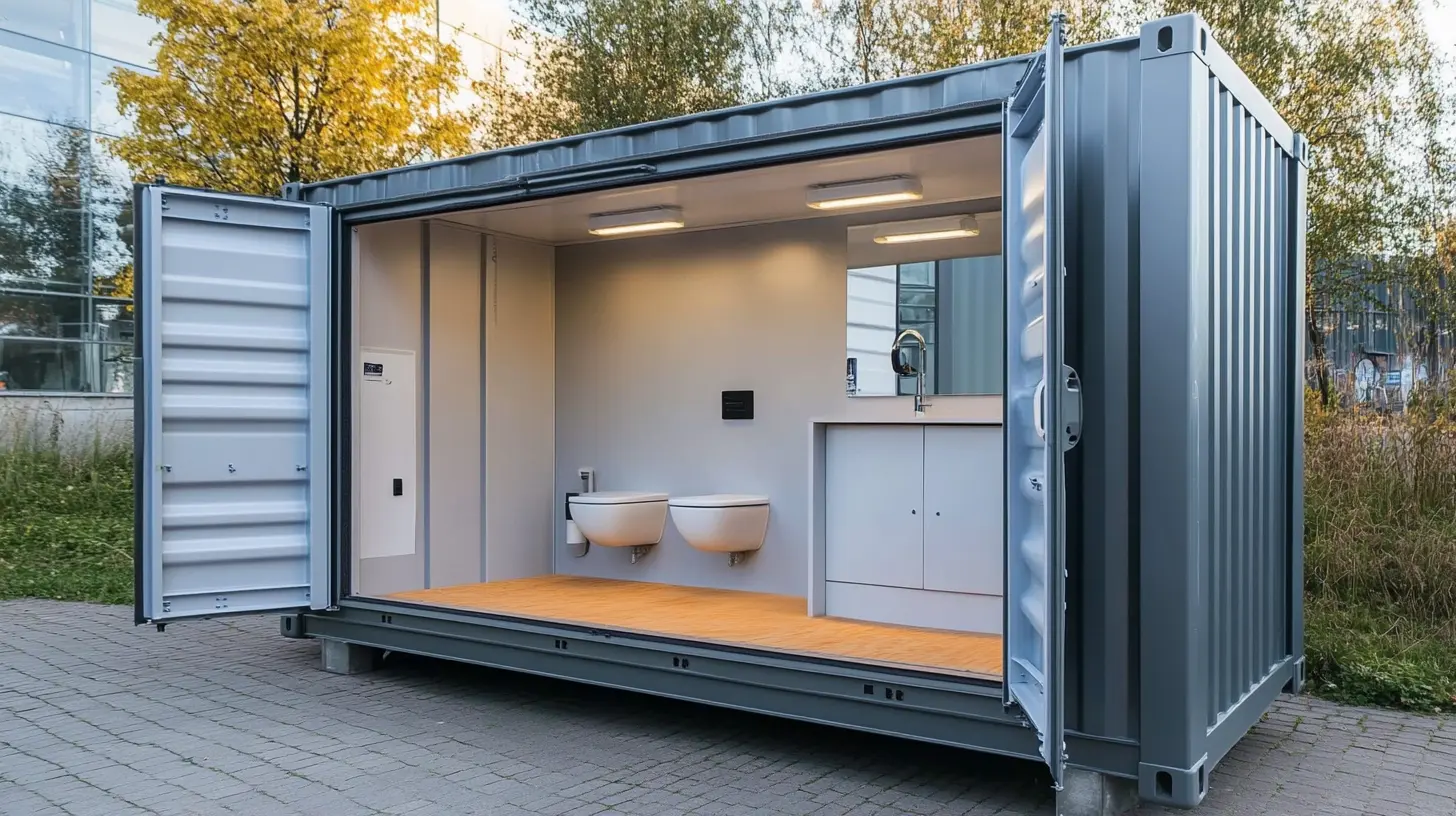
Installation Process & Site Preparation
Installing a portable cabin with toilet is a fast, low-disruption operation—usually completed within a day or two.
Still, precision in foundation, plumbing, and electrical setup ensures the cabin functions safely for years.
4.1 Site Preparation Essentials
A stable, level base is critical. Before delivery, ensure the location meets basic installation parameters.
| Parameter | Minimum Requirement | Ideal Condition | Impact |
| Ground Level | Even ±10 mm | Compacted soil or RCC pad | Prevents frame twist |
| Foundation Type | RCC / block | Reinforced RCC pad 6” thick | Long-term durability |
| Drain Slope | 1:40 minimum | PVC 110 mm gradient pipe | Smooth wastewater flow |
| Power Supply | 230 V | Generator / mains | Needed for instant use |
| Access Path | 10 ft clear width | Crane/forklift entry | Safe unloading |
Tip: For multi-site projects, keep two fixed foundation pads and rotate cabins as projects move.
4.2 Step-by-Step Installation Procedure
- Unloading:Crane or forklift positions the cabin on pre-cast RCC pads.
- Base Alignment:Spirit level used to check tilt (<5 mm).
- Plumbing Connection:Water inlet from tank; outlet to soak pit or septic.
- Power Setup:External 32A industrial socket connects to MCB inside cabin.
- Inspection: Verify all seals, switches, and drainage flow before commissioning.
4.3 Utility Connections
| Utility | Connection Method | Notes |
| Water Supply | Overhead / external tank (200–500 L) | Use 3/4″ PVC flexible hose |
| Drainage | PVC 110 mm pipe | Avoid sharp bends |
| Power Supply | 230 V AC, 2–3 kW | Use proper earthing |
| Lighting | LED tubes + exhaust fan | Controlled by single switch |
| Waste Disposal | Septic / bio-digester | As per local sanitation code |
Pro Insight: Many clients now connect bio-digester tanks to reduce servicing cost—these break waste into reusable water and gas.
4.4 Safety Measures During Installation
- Use only trained riggers for lifting operations.
- Maintain 5 m safety clearance from active equipment.
- Always switch off power during plumbing adjustments.
- Keep inspection hatch accessible for maintenance.
- Verify MCB and earthing resistance (<2 ohms).
5.1 Purchase Price Breakdown (By Size & Material)
| Cabin Size (ft) | Structure Material | Toilet Type | Price Range (₹) | Best For |
| 10×8×8.5 | FRP / MS | Single-seat | 55,000–75,000 | Guard room / small site |
| 20×10×9 | MS + PUF | 1–2 seat | 95,000–1,80,000 | Standard office setup |
| 30×10×9.5 | PUF / ACP | Toilet + sink | 2,25,000–3,50,000 | Project manager cabin |
| 40×10×9.5 | ACP / PPGI | Toilet + shower | 3,50,000–5,50,000 | Corporate / site HQ |
Note: Custom interiors (false ceiling, tiles, water heater) may increase cost by 10–15 %.
Value Point:
A 20 ft cabin with integrated toilet typically costs less than installing a masonry office and separate restroom — by nearly 40 %.
5.2 Rental Cost Analysis (Short-Term & Long-Term)
| Duration | Basic FRP Unit (₹/month) | PUF / MS Cabin (₹/month) | Luxury ACP Unit (₹/month) |
| 1 month | 9,000–12,000 | 15,000–18,000 | 25,000–30,000 |
| 3–6 months | 8,000–10,000 | 13,000–15,000 | 22,000–26,000 |
| 1 year+ | 7,000–9,000 | 12,000–14,000 | 20,000–22,000 |
Inclusions: Basic cleaning, transport (within 50 km), and installation.
Exclusions: Water, power, and septic servicing (charged per site).
Rental Insight:
Long-term rentals (6+ months) cost 20 % less per month and allow flexible relocation between projects.
5.3 ROI Comparison — Portable vs Permanent Construction
| Factor | Portable Cabin with Toilet | Brick & Mortar Office + Toilet | Difference |
| Construction Time | 2 days | 30–45 days | 90–95 % faster |
| Capital Outlay | ₹1.5–3.5 L | ₹4–8 L | 40–60 % cheaper |
| Relocation Option | Yes | No | Portable advantage |
| Maintenance Cost | Moderate (₹1–2k/month) | Variable (₹3–4k/month) | Lower recurring cost |
| ROI Period | 6–10 months | 3–5 years | Immediate payback |
Example ROI:
A contractor purchasing two 20 ft cabins for ₹3.6 lakh can recover the cost within 8–9 months by using them across multiple sites.
5.4 Operating Cost Components
- Servicing: ₹800–₹2,500/month depending on location.
- Transport: ₹5,000–₹8,000 within 100 km radius.
- Insurance: Optional, about 1 % of invoice value yearly.
- Utility Setup: ₹2,000–₹3,000 for plumbing and wiring.
- Depreciation: 10 % annually for accounting (cabins can last 12–15 years).
5.5 Market Cost Insight
According to verified 2025 industry data, the Indian portable toilet and prefab cabin market has crossed ₹7,900 crore, growing annually by 9.8 %.
Integrated cabins are driving this trend due to reduced land use and sustainability requirements.
For context, see the Wikipedia – Portable Toilet entry on global pricing patterns and hygiene standards influencing demand in developing economies.
5.6 Quick Cost Summary
- Setup time: 1–2 days
- Avg service life: 12–15 years
- Payback: 6–10 months (multi-site use)
- Annual maintenance: 4–6 % of unit cost
Portable cabins with toilets are not just temporary structures—they’re strategic cost assets that pay for themselves faster than almost any other site infrastructure. For sanitation-first units, check our Toilet Portable Cabins.
Materials, Durability & Maintenance
A well-built portable cabin with toilet stands strong through monsoon, heat, and relocation stress.
Material choice decides its life span, comfort level, and maintenance frequency. Every JBM Containers cabin is engineered for weatherproof endurance and minimal upkeep.
6.1 Common Materials Used in Portable Cabins
| Component | Standard Material | Premium Option | Durability (Years) | Remarks |
| Frame | IS 2062 MS Steel | Galvanized Steel | 12–15 | Rust-resistant, load-bearing |
| Wall Panels | FRP (Fiber Reinforced Plastic) | PUF / ACP | 8–15 | Thermal & sound insulation |
| Roof | PPGI Sheet (2-way sloped) | PUF Insulated Roof | 10–12 | Leak-proof with reflective coat |
| Floor | Marine Ply + Vinyl | Cement Board + Vinyl | 8–10 | Anti-skid & waterproof |
| Windows | uPVC + MS Grill | Toughened Glass | 10–12 | Reduces dust ingress |
| Toilet Fixtures | FRP / Ceramic | Ceramic (Jaguar / Hindware) | 5–10 | Easy to clean, long-lasting |
Insight: PUF and ACP panels deliver 20–30 % higher insulation than FRP walls, maintaining indoor comfort even in 45°C heat.
6.2 Durability Comparison by Climate Zone
| Climate Type | Ideal Material Combo | Expected Life (Years) | Recommended Coating |
| Coastal (humid) | Galvanized MS + FRP | 10–12 | Anti-corrosive epoxy |
| Dry / Desert | PPGI + PUF Panels | 12–15 | Heat-reflective PU coat |
| Hill Region | ACP + PUF | 15+ | Moisture-resistant PU paint |
| Urban / Industrial | MS + ACP | 10–14 | Dust-proof enamel paint |
Durability improves significantly when cabins are cleaned quarterly and repainted every 3–4 years.
6.3 Maintenance Schedule
| Task | Frequency | Time Required | Cost Estimate (₹/year) |
| Cleaning & sanitation | Weekly | 30–60 mins | 1,200–1,500 |
| Electrical inspection | Quarterly | 1 hr | 500–700 |
| Paint touch-up | Yearly | 3–4 hrs | 2,000 |
| Panel re-sealant | Biennial | 2 hrs | 1,000 |
| Plumbing & tank check | Monthly | 1 hr | 800 |
Total Annual Cost: ≈ ₹5,000–₹7,000 for standard-size cabin.
Downtime: Less than 2 days per year when serviced regularly.
Installation, Servicing & Operating Costs
Even the best-built portable cabin with toilet needs correct setup and steady upkeep to reach its full lifespan.
Installation costs are one-time, but servicing and cleaning decide whether it feels new after one year—or worn out after three.
7.1 Typical Installation Cost Breakdown
| Component | Description | Estimated Cost (₹) | Frequency |
| RCC Foundation Pads | 4–6 blocks or continuous base | 3,000–7,000 | One-time |
| Water & Drain Connection | PVC piping, fittings, traps | 2,000–4,000 | One-time |
| Electrical Setup | Power inlet, MCB, switches | 1,500–3,000 | One-time |
| Transport & Crane | Unloading and placement | 5,000–8,000 (100 km radius) | Per move |
| Testing & Commissioning | Pressure, leak, insulation test | Included | One-time |
Total Approximation: ₹12,000–20,000 for a standard 20×10 ft unit.
If base pads are reused across sites, only lifting and transport costs apply in subsequent moves.
7.2 Servicing & Cleaning Frequency
| Task | Frequency | Service Duration | Avg. Cost (₹/visit) | Responsible Party |
| Interior Cleaning | Daily / Weekly | 30 – 45 min | 300–400 | Site cleaner |
| Tank Emptying (non-bio) | Weekly / Biweekly | 1 hr | 600–1,000 | Vendor |
| Bio-digester Check | Monthly | 45 min | 400 | OEM |
| Plumbing Leak Check | Monthly | 30 min | 200 | Site maintenance |
| Paint & Panel Inspection | Yearly | 2–3 hr | 2,000 | OEM service |
| Electrical Load Test | Half-yearly | 1 hr | 500 | Electrician |
Tip: For clusters of 5+ cabins, negotiate an annual comprehensive service contract—saves ~20 % on total recurring cost.
FAQs on portable cabin with toilet
-
- What is a portable cabin with toilet?
It’s a prefabricated modular cabin that combines an office or workspace with an attached restroom. These units include plumbing, lighting, and ventilation, offering quick installation and hygienic facilities for worksites, remote areas, and temporary offices.
- How much does a portable cabin with toilet cost in India?
Prices range from ₹90,000 to ₹3,50,000 depending on size, material, and features. Basic FRP units are budget-friendly, while PUF or ACP cabins with fittings like sinks or showers cost more. Transport and installation may add 5–10% extra.
- Can portable cabins with toilets be customized?
Yes. You can choose layout, size, toilet type, flooring, insulation, and fittings. Custom options include solar lighting, bio-digester tanks, or AC-ready walls for comfort and compliance across industrial or corporate use.
- How long does installation take?
Most units are ready within one day once the RCC base and utility lines are prepared. Larger executive models may need two days. No wet construction is required, so there’s minimal site disruption.
- What materials are used to build these cabins?
Frames are made from mild steel or galvanized steel, while walls use PUF, ACP, or FRP panels for insulation and durability. Interiors have marine-ply flooring, vinyl finish, and ceramic sanitary fixtures for easy cleaning.
- Are portable cabins with toilets suitable for long-term use?
Absolutely. With proper maintenance, these cabins last 12–15 years. Premium versions with insulated panels, anti-rust coating, and bio-digester systems can last even longer in all weather conditions.
- Do portable cabins need plumbing connections?
They come with pre-fitted internal plumbing. External connection to a water tank and drainage outlet is required. Bio-digester models can operate independently, making them ideal for remote locations.
- Can they be relocated easily?
Yes. Each unit has lifting hooks and forklift slots, allowing relocation within hours. Cabins can be reused across multiple projects without affecting structure or waterproofing.
- Are these cabins compliant with Indian standards?
Yes. They follow BIS and NBC codes for structure and plumbing, and Swachh Bharat Mission norms for sanitation. Many manufacturers also maintain ISO 9001 certification for consistent quality.
- Where can portable cabins with toilets be used?
They’re ideal for construction sites, factories, events, schools, offices, and rural projects. Anywhere that needs fast, hygienic, and movable restroom facilities can benefit from these all-in-one prefab solutions.