Product Overview
Detailed information about Cargo Container Office
Cargo Container Office — Cargo-Grade Steel for Industrial Environments That Eat Standard Units
A cargo container office is the right specification when your deployment environment will degrade a standard 16-gauge office-conversion unit faster than its operational life justifies. Salt air at coastal ports, chemical vapour at petrochemical plants, abrasive dust at mining sites, slag spatter at steel mills, monsoon-driven humidity cycles at coastal infrastructure, and forklift impact at heavy industrial yards — these are environments where a standard ISO conversion shows paint blistering at 14 to 18 months, panel pitting at 24 months, and frame deformation at 30 to 36 months. Cargo grade is the procurement upgrade that prevents this.
When Does Standard Grade Fail? Six Indian Environments That Demand Cargo Grade
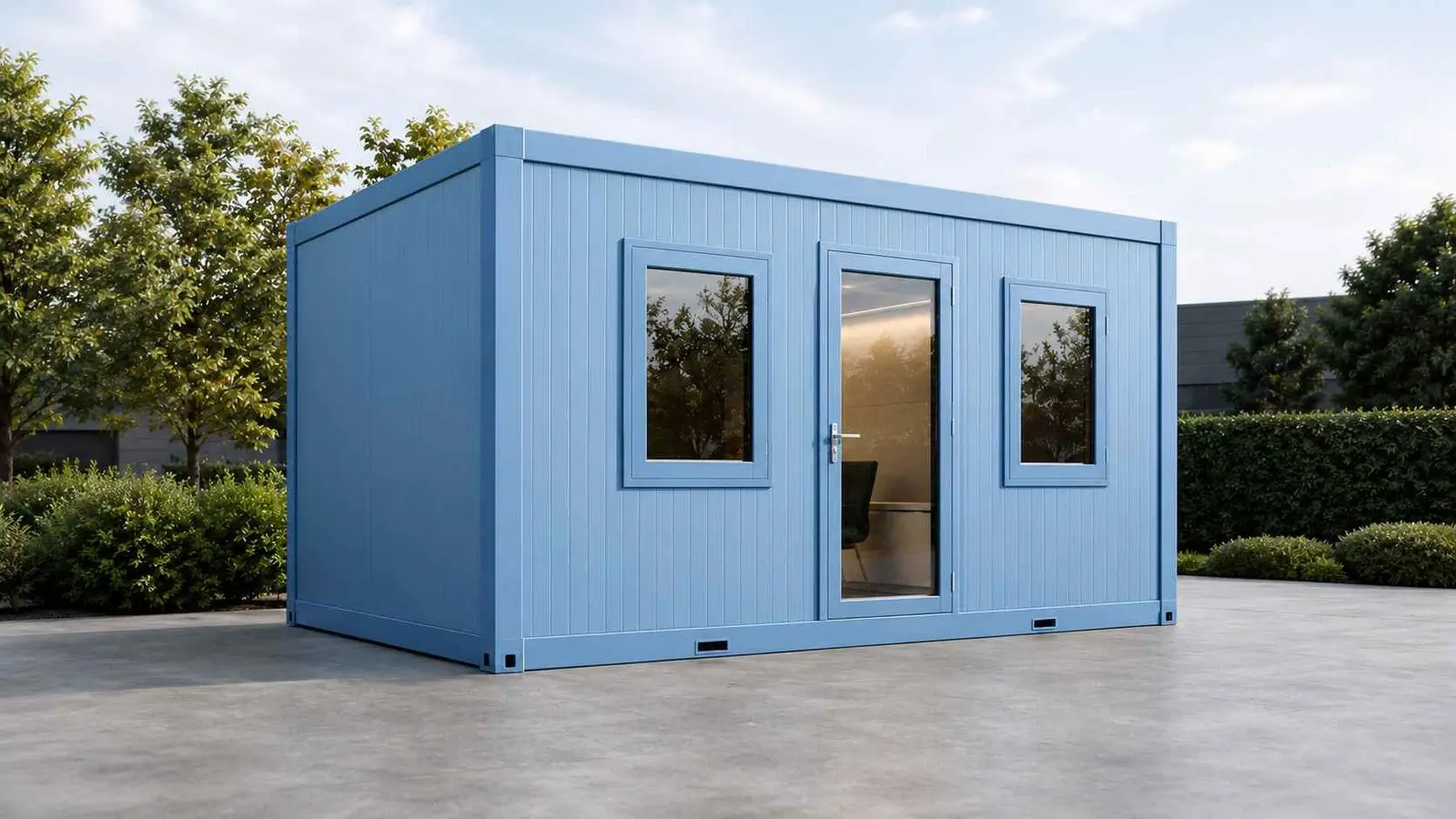
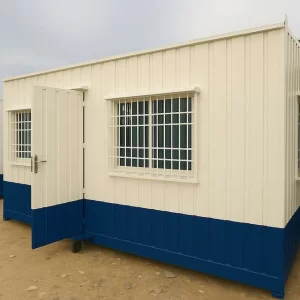
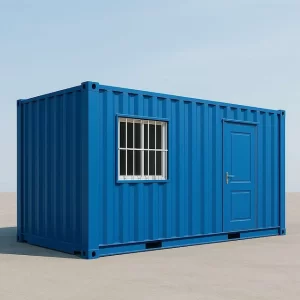
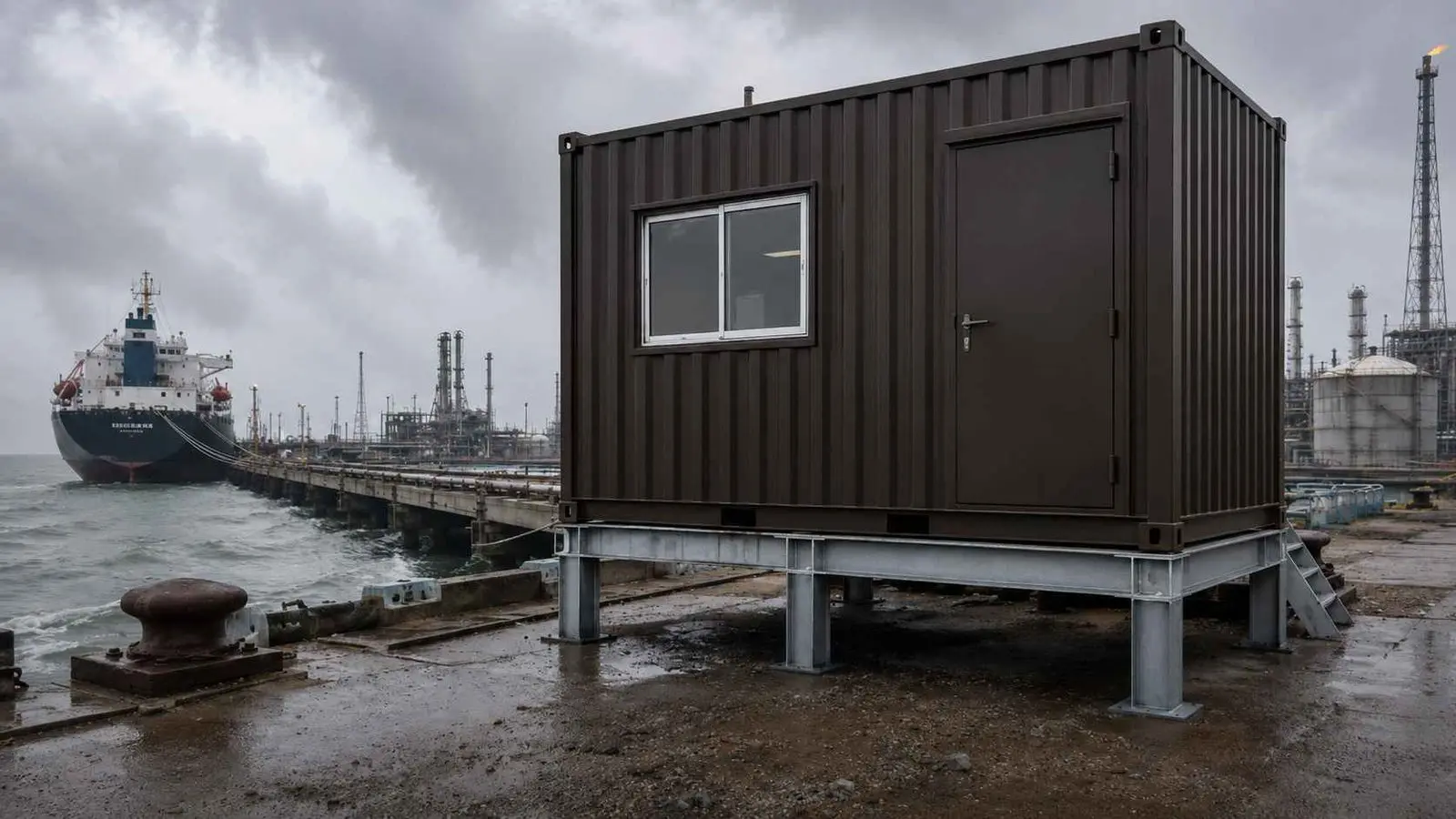
argo container office installed on a raised platform at a coastal refinery jetty, built for salt-air, humidity, and long industrial service life.
Six Indian industrial environments where the procurement file should specify cargo grade from the outset:
Major port yards — JNPT, Mundra, Visakhapatnam, Krishnapatnam, Kandla. Salt-air corrosion, container-handler proximity, 24×7 operations.
Chemical and petrochemical corridors — Dahej, Jamnagar, Hazira, Vizag chemical zone. Vapour exposure, occasional acid mist, regulatory inspection regimes that flag visible structural degradation.
Mining belts — Bellary iron ore, Korba and Singrauli coal, Kudremukh, Goa bauxite zones. Abrasive dust, heavy-vehicle proximity, blast-area shockwave exposure on some sites.
Steel mills and heavy fabrication yards — Jamshedpur, Bhilai, Rourkela, Vizag Steel, Bellary steel cluster. Heat exposure, slag spatter, forklift impact zones, gantry crane traffic.
Coastal infrastructure projects — port expansions, breakwaters, refinery jetties, naval base civil works. Direct salt-air exposure, monsoon-driven humidity, 5 to 8-year project horizons.
Defence, ordnance, and explosives-handling sites — shock and vibration spec floors, restricted-access perimeter requirements, longer-than-civilian service-life expectations.
For projects in moderate environments where the office must hold the same site for 18 to 36 months, our long-duration container office is a different procurement decision — duration spec, not grade spec.
What Is a Cargo Container Office?
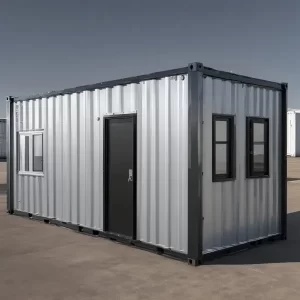
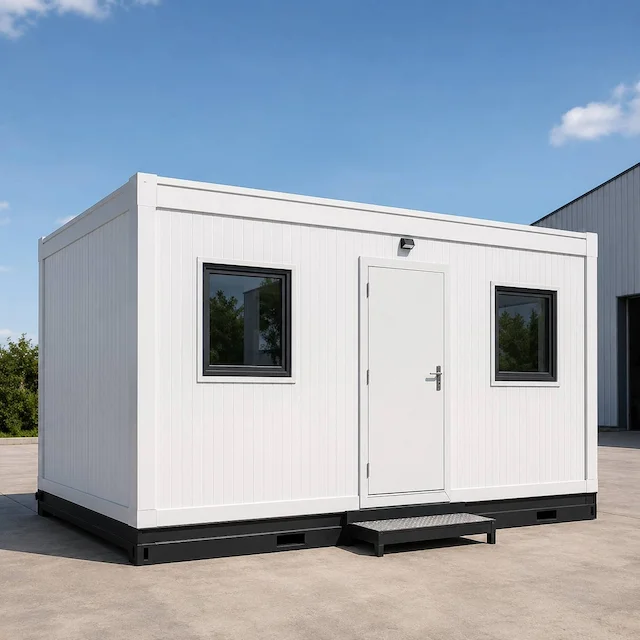
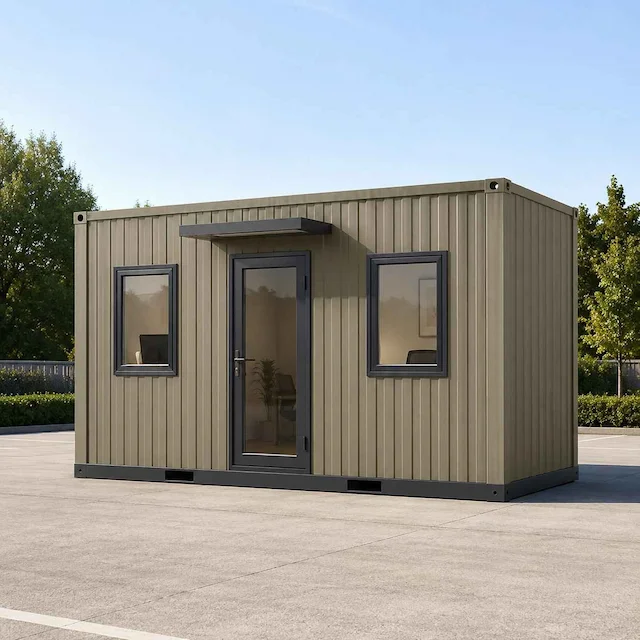
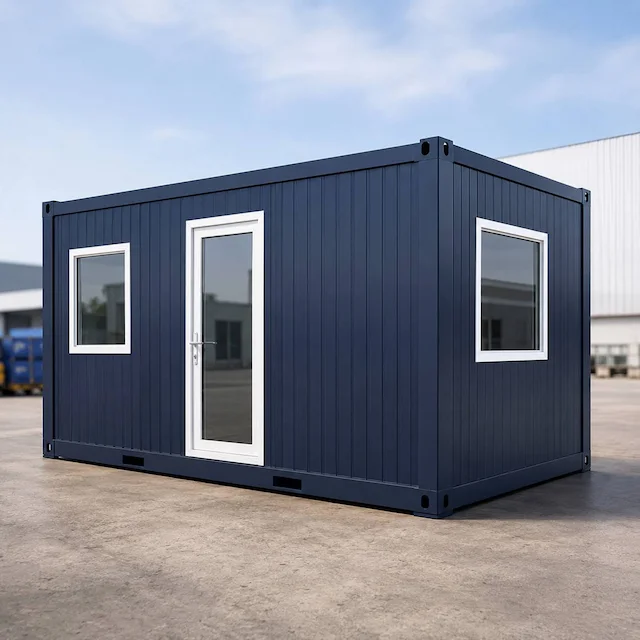
Cargo container office with a clean exterior layout, one entrance door, two windows, and durable corrugated panel construction.
Six specification dimensions distinguish a standard office-conversion unit from a cargo-grade unit. Each one moves expected service life forward by 6 to 18 months in aggressive environments.
| Specification | Standard 16-Gauge | Cargo-Grade 14-Gauge |
|---|---|---|
| Wall steel | 1.6mm MS, painted | 2.0mm Corten A/B, weathering |
| Frame and cross members | 3mm IS 2062 | 4 to 4.5mm IS 2062 |
| Paint system | Synthetic enamel topcoat | Marine-grade epoxy primer + PU topcoat |
| Salt-spray rating (ASTM B117) | 200 to 400 hours | 1,000 to 2,000 hours |
| ISO certification | Not required | ISO 1496-1, CSC plate |
| Service life in aggressive environments | 4 to 6 years | 8 to 12 years |
For projects in non-aggressive environments where the size and configuration matter more than the steel grade, our standard shipping container office covers the 20-ft and 40-ft catalogue with standard ISO specification.
Failure Modes Cargo Grade Prevents — What Goes First on Standard Units
Five failure modes are predictable on standard 16-gauge units in aggressive environments. Each is a procurement-tender disqualifier on a long-horizon project.
Paint blistering. First visible at 14 to 18 months on coastal sites and 18 to 24 months at chemical corridors. Synthetic enamel topcoat lifts at corner welds and door-frame junctions where moisture accumulates.
Panel pitting. Localised steel loss begins at 24 months at chemical plants and 30 months at port yards. Once pitting penetrates the painted surface, propagation accelerates.
Doorframe corrosion. Hinge welds and door-bottom seals degrade at 18 to 24 months at coastal sites. Door eventually fails to close flush, breaking the weather seal and accelerating interior degradation.
Panel deformation under impact. Forklift glancing blows that a 14-gauge cargo-grade panel absorbs without permanent deformation will dent a 16-gauge panel visibly. Once deformed, the panel can no longer be repainted to original spec — it must be replaced.
Base-rail concrete-spatter erosion. At sites adjacent to live concreting (port expansions, refinery construction), alkaline concrete-water splash erodes standard paint within 8 to 12 months. Cargo-grade marine epoxy survives 24 to 36 months under the same exposure.

Frequently Asked Questions
Recertified ISO cargo container or new-build cargo-grade — which is right for my project?
Recertified ISO is right for projects with under-8-year expected service life where mill test certificates and inspection reports are available from the original consignment — Rs 4,80,000 to Rs 5,40,000 for a 20-ft unit. New-build cargo-grade is right for 10-plus-year service in aggressive environments and for tenders requiring fresh manufacturer certification — Rs 6,20,000 to Rs 7,80,000 for a 20-ft unit. The decision driver is service-life expectation and tender-documentation requirement, not budget.
What salt-spray rating should a cargo-grade unit at a coastal port carry?
ASTM B117 minimum 1,000 hours for moderate coastal exposure (1 to 5km from shoreline), and 2,000 hours for direct salt-air exposure within 500m of the shoreline. Standard office-conversion units typically test at 200 to 400 hours. Specify the rating in the procurement document — paint system selection (epoxy primer + polyurethane topcoat versus marine-grade epoxy + PU) is calibrated to hit the specified rating.
Will a cargo-grade unit retain its CSC plate, and does that matter for office use?
Yes on recertified-base builds, with the five-year ACEP recertification cycle continuing. CSC retention does not affect office function but is required if the unit will ever be relocated by sea or rail freight. New-build cargo-grade units carry manufacturer’s structural certification per ISO 1496-1 instead of CSC — equally valid for office use, equally accepted on procurement tenders.
What is the typical lead time difference between standard and cargo-grade?
Standard 16-gauge office-conversion units ship in 7 to 14 working days. Recertified-base cargo-grade builds ship in 10 to 14 working days — base unit sourcing adds 3 to 5 days. New-build cargo-grade ships in 14 to 21 working days; mill test certificate procurement and TPI coordination add 5 to 8 days to the standard fabrication timeline.