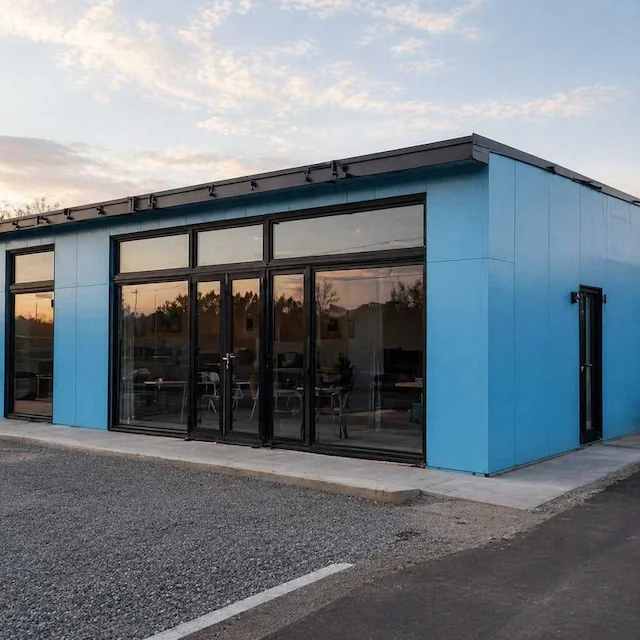
Product Overview
Detailed information about Prefab Buildings
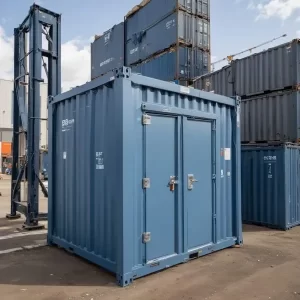
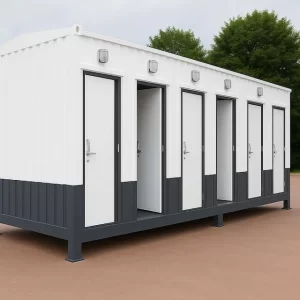
Prefabricated house: A single-family or site accommodation structure for residential buyers or project engineers needing a bunkhouse. If you are building or buying a home, or need site accommodation for a small team, see our prefabricated houses page.
Industrial shed: A single-span, open-floor steel structure for factories, warehouses, and logistics facilities. No interior partitions — maximum clear floor area. Spans from 9m to 50m. See our industrial sheds page.
Pre-engineered building (IS-certified supply): If you are sourcing fabricated steel components with IS 2062 documentation to your own erection team at large industrial scale, see our pre-engineered buildings page.
If your requirement is a multi-room building for commercial or industrial use — you are in the right place.
What Commercial and Industrial Buyers Use Prefab Buildings For
Prefab buildings we serve buyers who need a functioning, multi-room building faster than conventional construction allows.
Office and workspace buyers use prefab buildings for head offices, branch offices, administrative blocks, training centres, and multi-floor corporate buildings. Retail and commercial buyers use them for showrooms, outlets, service centres, and commercial complexes requiring a commercial exterior finish and public-facing presentation.
Industrial production buyers need multi-room factory buildings that combine production floor, quality room, supervisor cabin, canteen, and washroom under one roof — without the open-span limitation of a shed. Institutional and campus buyers use prefab buildings for schools, clinics, staff quarters, guesthouses, and utility buildings on infrastructure projects and manufacturing campuses.
For buyers who need an office block specifically, our prefab office building subpage covers office-specific configurations. For retail and commercial outlet buyers, our prefab commercial building subpage covers commercial exterior and interior options.
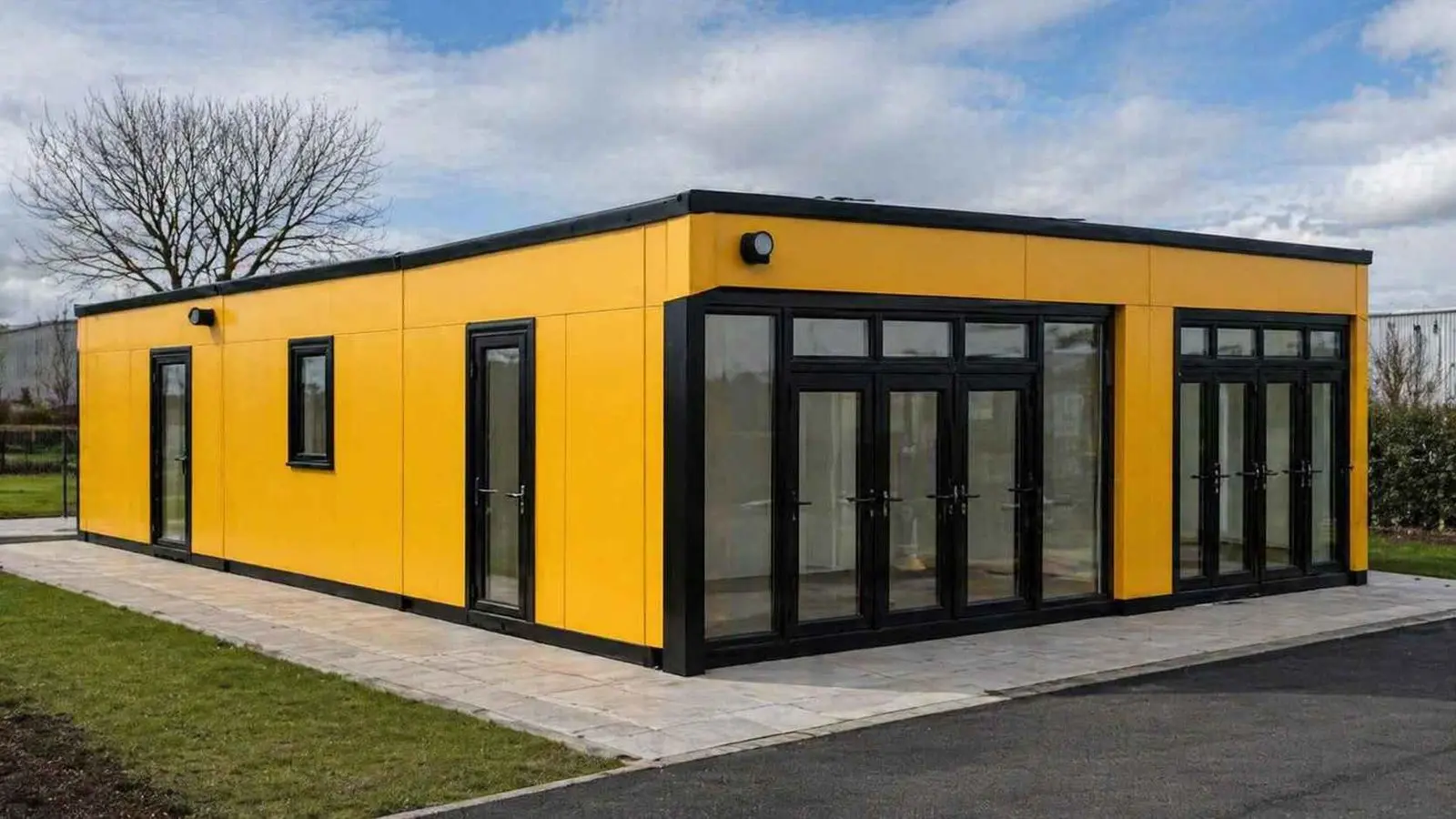
Interior Finish for Commercial Use — What the Inside Actually Looks Like
A prefab building can be delivered in two interior finish standards — industrial grade and commercial grade.
Industrial grade: Exposed metal stud framing with insulated sandwich panel walls. Suitable for production rooms, storage areas, and back-of-house spaces where finish appearance is secondary to function.
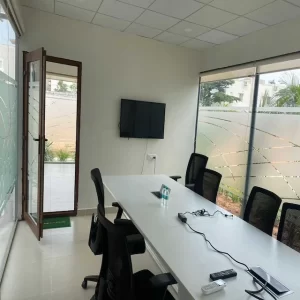
Commercial grade: PVC-laminated or pre-painted internal wall panels with a flush finish. False ceiling in gypsum or PVC profiles. Vinyl or tile-ready flooring. Pre-wired electrical conduit with switchboard locations. Suitable for offices, reception areas, showrooms, clinics, and any space where your team or clients occupy the interior daily.
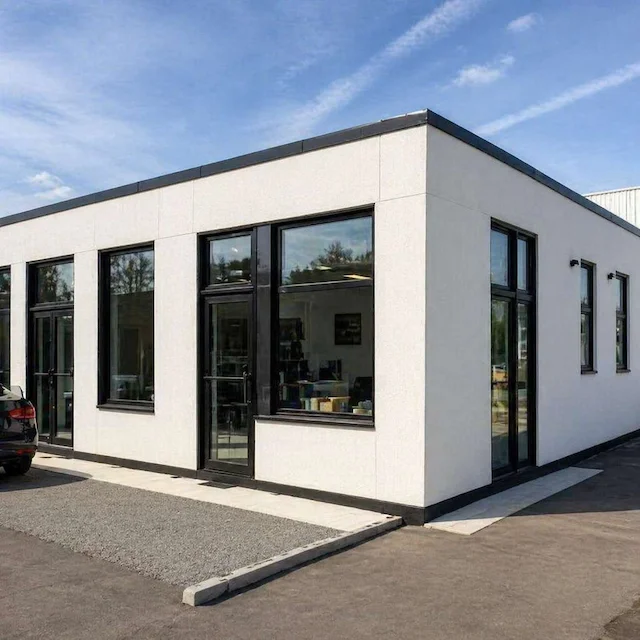
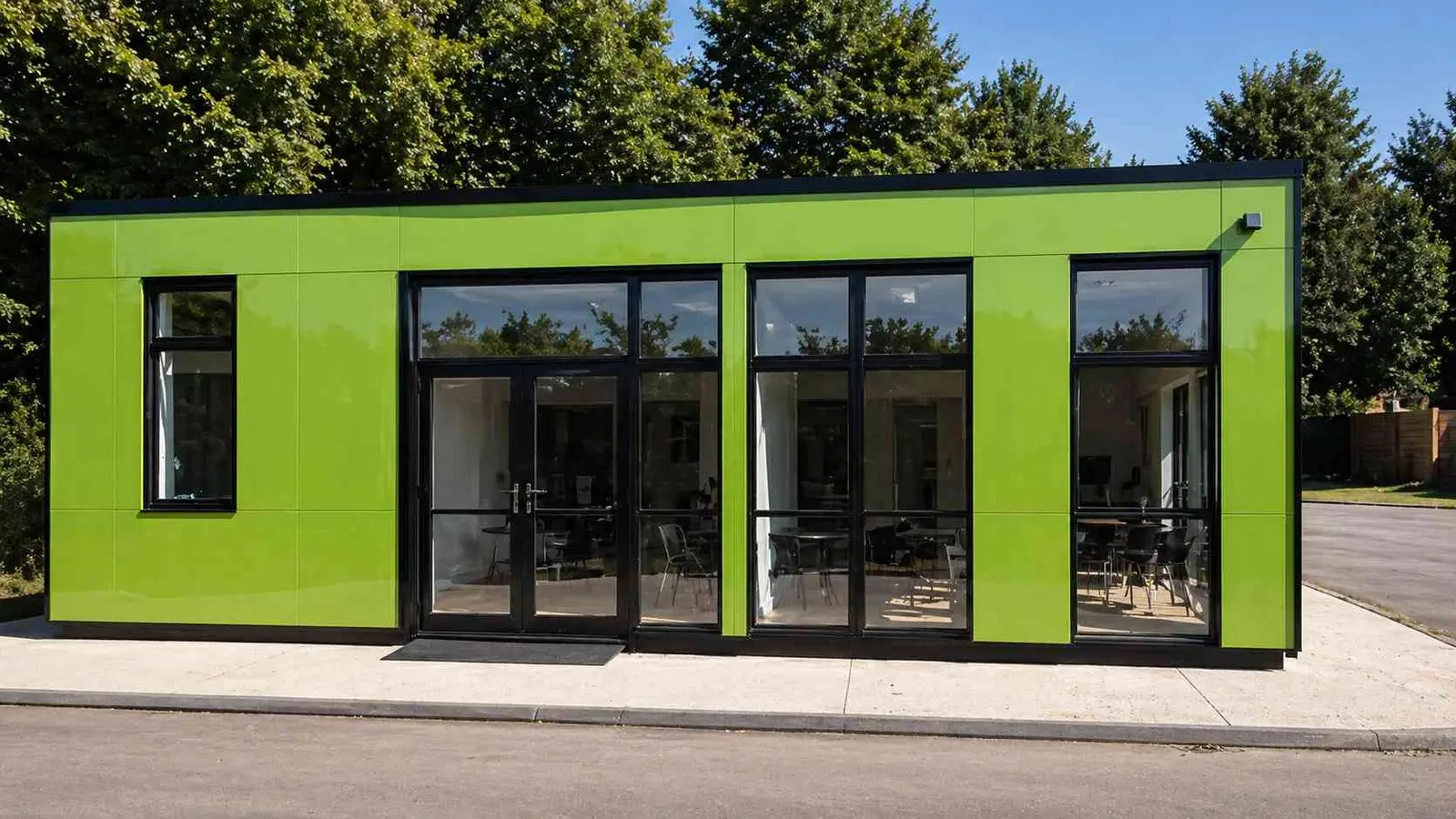
Exterior facade: Standard colour-coated corrugated metal panel is the default. A textured or painted flat-panel facade is available for commercial buildings where the exterior represents the brand. Window and glazing configurations — fixed glass panels, sliding windows, or curtain wall sections — are confirmed at the brief stage.
For buyers whose requirement is industrial-grade interior rather than commercial-finish, our prefab industrial building subpage covers industrial format buildings.
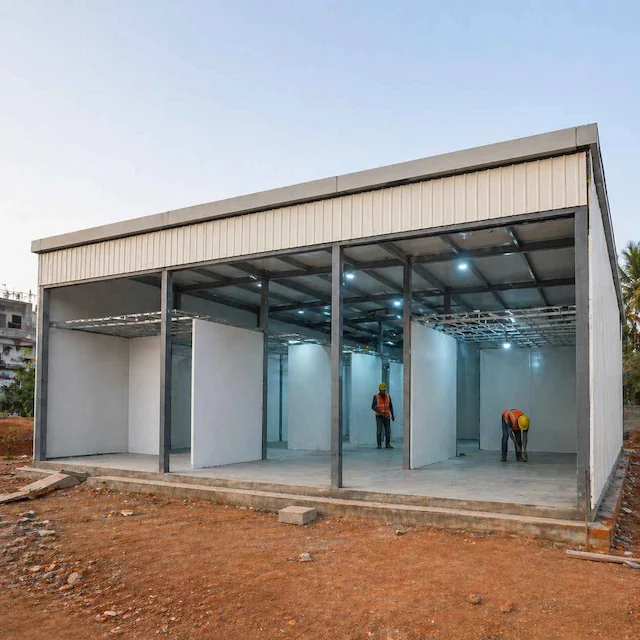
Office and workspace: prefab office building — multi-room office configurations · modular office building — expandable room-by-room workspace
Commercial retail and showroom: prefab commercial building — commercial exterior and interior finish
Industrial production and processing: prefab industrial building — industrial-grade multi-room factory buildings · modular office building — modular phase-by-phase construction
Multi-floor and multi-bay structures: prefabricated buildings — large-scale multi-floor configurations
Purchase intent: buy prefabricated buildings — buyers ready to place an order
Frequently Asked Questions
Does a prefab building require a permanent foundation?
Yes. A prefab building requires a concrete plinth foundation with anchor bolts set to layout drawing. Unlike a portable cabin, a prefab building is a permanent or semi-permanent structure intended for ongoing occupancy — the foundation ensures structural stability for the design life. Foundation work is arranged by your civil contractor using the anchor bolt layout we provide within 5 working days of order confirmation.
What is the minimum size for a prefab building?
We builds prefab buildings from a minimum of 400 sq ft of covered area — typically a small 2 to 3 room office or utility building. Below 400 sq ft, a portable cabin or portable office cabin is typically more economical. Most commercial and industrial prefab building orders start at 1,000 sq ft and above.
Can a prefab building be relocated after installation?
A prefab building is designed as a permanent structure. While the components are bolt-together and theoretically separable, relocation involves dismantling the building, transporting individual panels and frames, and re-erecting on a new foundation — significant cost and time. If you anticipate relocation within 5 years, discuss this at brief stage. If relocation is a firm requirement, a modular portable cabin system is a better fit.
What local authority approvals does a prefab building require in India?
Prefab buildings in India generally require the same building plan approval as conventional construction — local municipal authority, panchayat, or industrial authority approval depending on the plot classification. provides structural drawings, load calculations, and engineering documentation for your approval submission. Commercial plots in KIADB, GIDC, SIDCO, and industrial zones typically require structural engineer certification — included with every order.
How long does delivery and installation take from order confirmation?
A standard single-storey prefab building up to 3,000 sq ft is fabricated and delivered in 7 to 21 working days from order confirmation depending on specification and site distance from our Bangalore or Greater Noida facilities. On-site assembly by our installation crew takes an additional 5 to 10 working days. Total from order to occupancy: 6 to 8 weeks for most standard configurations.